
Choosing the top Entrance Front Door manufacturers in China takes more than comparing polished catalog photos. A door may look substantial online yet feel light at the handle. Buyers should examine the frame, panel construction, finish, seals, and hardware as one system. Louis Sullivan, an influential architect, wrote, “form ever follows function.” That principle fits entrance doors: appearance matters, but daily performance matters too.
This guide compares manufacturers through practical questions: What materials and configurations do they offer? Can they provide clear specifications, samples, and consistent production details? How do they handle customization, packaging, and communication? These points help separate a capable supplier from a persuasive sales page. Still, no shortlist is perfect. Product ranges change, and published specifications do not always reveal how a door performs after years of use.
For a fair comparison, buyers should match each manufacturer’s offering to the project. A coastal home may need different finish and corrosion considerations than an urban apartment entrance. Ask for written details on dimensions, finishes, hardware, and installation requirements. Check sample quality under natural light; a small color difference can look obvious beside stone or wood. This article will introduce notable Chinese manufacturers and explain what to verify before requesting a quotation. Treat rankings as a starting point, not a guarantee. A careful review takes time, and sometimes the best choice is not the most famous name.
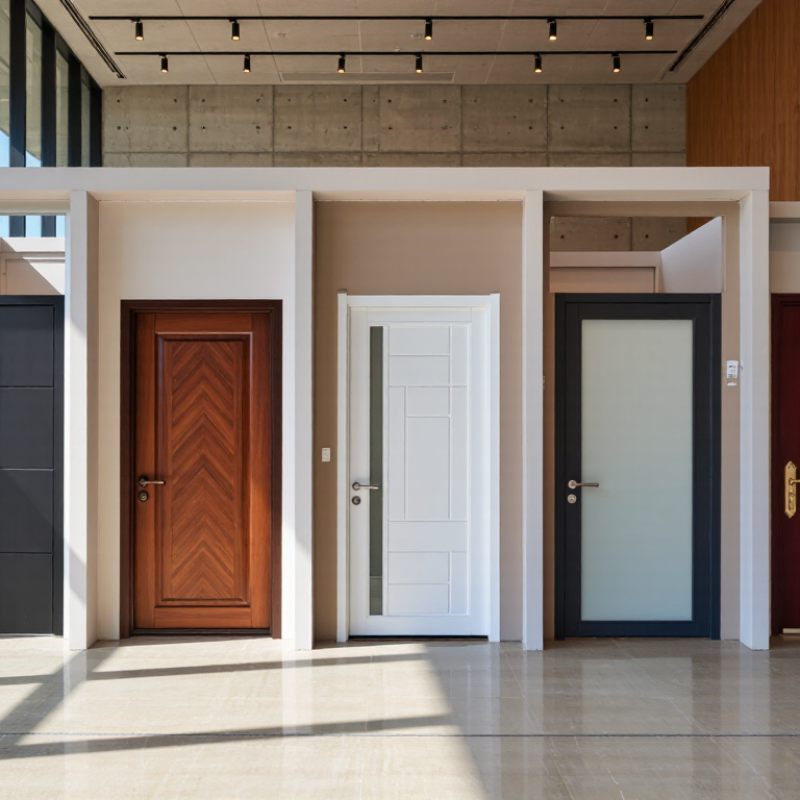
China’s entrance door industry is better understood as a network than as a single production line. Manufacturers often work within regional industrial clusters, where metal processing, glass, locks, hinges, coatings, and packaging suppliers operate nearby. This proximity can shorten sourcing time and make custom orders more practical. It does not guarantee consistent quality.
Production is commonly divided by material and product type. Some factories focus on steel security doors, while others specialize in aluminum, timber, or mixed-material entrance systems. Within a factory, cutting, forming, welding, surface treatment, assembly, and inspection may be handled by separate teams. Buyers should ask which steps are performed in-house and which depend on outside suppliers. Small details matter. A door may have a solid frame but poorly aligned hinges.
Export-oriented manufacturers may also provide drawings, finish samples, packaging options, and inspection records. These are useful checkpoints, not proof by themselves. A powder-coated sample can look smooth under showroom lighting, yet perform differently after transport or prolonged exposure to weather. Specifications should state dimensions, core construction, hardware, finish, and acceptable tolerances. The structure is efficient, but not perfectly neat: suppliers and factories can share responsibilities in ways that are difficult to see from a catalog. A clear production scope helps buyers compare manufacturers on more than price.
Chinese entrance-door manufacturers commonly offer single-leaf security doors, insulated entry doors, pivot doors, and double-leaf designs. Steel models often use galvanized skins around honeycomb or mineral-wool cores. They suit busy entrances and can accept wood-grain finishes. Aluminum doors are lighter and resist corrosion, while thermal breaks help limit heat transfer. Solid-wood and engineered-wood doors bring a warmer, more tactile look. Some catalogs also pair a main door with narrow glass sidelights. Check the actual sample.
Material choice affects more than appearance. UNEP and the Global Alliance for Buildings and Construction reported in their 2023 Global Status Report that
buildings and construction account for 34% of global energy demand and 37% of energy- and process-related CO₂ emissions.
These figures describe the whole sector, not doors alone, but they underline why insulation and airtight sealing deserve attention. For cold or noisy sites, compare core construction, perimeter seals, frame details, and measured thermal or acoustic performance. A thick slab may feel reassuring, yet thickness alone proves little. Ask for test records and inspect how the lock, hinges, and threshold meet the frame. A showroom sample cannot reveal years of wear.
China’s entrance door manufacturers often specialize by material, building type, and climate needs. Residential security-door makers commonly work with reinforced steel, multi-point locks, and durable surface coatings. Some focus on insulated steel doors, while others produce lighter aluminum models with thermal breaks and narrow glass panels. Built for daily use.
Solid-wood and engineered-wood producers tend to emphasize finish, panel design, and interior-to-entry transitions. Commercial manufacturers may prioritize larger dimensions, frequent-use hardware, and consistent production across project orders. These specialties can overlap, so a product label alone says little about performance. Check the door’s core material, frame construction, lock compatibility, finish thickness, and installation tolerances. Ask for relevant test documents and inspect a physical sample where possible. A specification sheet cannot fully predict how a door will perform after months of rain, sun, and repeated opening. Factory quality checks matter, but on-site fitting can still be uneven. The right supplier depends on the building, local weather, and maintenance expectations.
When comparing entrance front door manufacturers in China, request recent test reports for the exact door construction, not just a certificate for a similar product. Check the frame material, hardware, seals, and glass configuration against the tested sample. For export projects, confirm that certificates and laboratory reports match the destination market’s requirements. A factory audit can also reveal how workers control welding, coating thickness, and final dimensions. UNEP’s 2023 Global Status Report for Buildings and Construction estimates that buildings produced 37% of global energy- and process-related carbon emissions. This is not a door-specific figure, but it underlines why air leakage and insulation deserve attention.
Customization is more than choosing a color. Send manufacturers a clear schedule covering opening direction, wall thickness, threshold height, finish, lock preparation, and hardware. Ask for shop drawings and a physical finish sample before production. Compare stated tolerances with inspection records, and request water, air, and structural test evidence where relevant. For coastal sites, ask how the finish resists corrosion and how maintenance is specified. I would not treat a polished showroom as proof; I once overlooked the difference between a sample finish and a full-size door. Small details matter. Manufacturers that document revisions and explain what cannot be customized are often easier to assess reliably.
Use this evidence-based comparison framework to evaluate suppliers. It is not a company ranking; requirements vary by door type, project, and destination market.
| Comparison Dimension | Evidence to Request | How to Compare | What a Strong Result Looks Like |
|---|---|---|---|
| Product type and intended use | Product specification identifying the door as, for example, a steel security door, an exterior building door, or a fire door. | Check that the quoted product category matches the intended use and applicable local building requirements. Do not treat different door categories as interchangeable. | The supplier clearly identifies the tested product type, intended application, and any limits on use. |
| Applicable standards | Test reports and product documents naming the standard, edition, tested configuration, and results. Examples include GB 17565-2007 for security doors and GB 12955-2008 for fire doors, where applicable. | Confirm that the cited standard is relevant to the door type and project. Check the report date and whether the tested construction matches the quoted model. | Reports are complete and traceable, with the test scope and product configuration clearly stated; applicable requirements are confirmed for the destination market. |
| Certification and report validity | Relevant certificates, product test reports, issuing-body details, and certificate or report numbers. | Verify documents with the issuing body where possible. Check validity, product scope, model coverage, and whether certification is required for the specific product and market. CNAS accreditation and CMA inspection-testing qualification are distinct credentials; check the applicable scope. | Documents are current and independently verifiable, and their scope covers the supplied product rather than a materially different model. |
| Materials and construction | Bill of materials, material grades or specifications, section and panel details, finish description, hardware list, and approved drawings. | Compare the documented construction with the quotation and sample. Confirm that material, panel, frame, lock, hinge, and finish specifications are written into the purchase contract. | Critical components and materials are specified clearly, consistently, and in a way that can be checked during production or inspection. |
| Quality control and traceability | Incoming-material checks, in-process inspection records, final inspection checklist, defect-handling procedure, and batch or order identification. | Ask how dimensions, finish, operation, hardware, and order specifications are checked. Compare the written inspection plan with the product and contract requirements. | Inspection criteria are documented, results can be linked to the order, and nonconforming products have a defined corrective-action process. |
| Customization capability | Dimension range, opening direction, frame details, finishes, glazing options, hardware choices, drawings, and the approval process for custom orders. | Confirm how site measurements are supplied and approved, which options affect price or lead time, and whether custom changes affect test evidence or certification scope. | The supplier provides a controlled drawing-approval process and records the final dimensions, configuration, finish, and hardware before production. |
| Performance requirements | Test results or declared performance for relevant needs such as security, fire resistance, weather resistance, thermal performance, or sound insulation. | Compare results only when test methods, product configuration, and conditions are comparable. Set project-specific acceptance criteria rather than assuming one value applies to every door. | Performance claims are supported by relevant evidence for the quoted configuration and are matched to the project requirements. |
| Samples and pre-shipment inspection | Approved sample or finish swatch, pre-shipment inspection plan, inspection report, and defect-resolution terms. | Agree in writing on the sample reference, inspection timing, acceptance criteria, and responsibility for resolving defects before shipment. | The production order is checked against approved samples and drawings, with inspection results shared before dispatch. |
| Commercial and after-sales terms | Written quotation, minimum order quantity, production lead time, packaging details, warranty terms, spare-parts policy, and claim procedure. | Compare like-for-like specifications and delivery terms. Treat warranty length and lead time as contract terms to verify, not as universal industry standards. | Price, scope, schedule, packaging, warranty coverage, exclusions, and remedies for defects are stated clearly in the contract. |
When comparing entrance front door manufacturers in China, look beyond catalog photos. Ask for the exact material, core construction, finish, hardware, and available dimensions. A steel door sample may look solid, yet its frame and weather seals deserve equal attention. Request test reports for the precise model and configuration you plan to order. Generic documents are not enough. Confirm export packing, container loading plans, lead times, and which party handles freight arrangements. Small details matter.
Tips: Send a written specification with drawings, opening measurements, finish samples, and hardware requirements. Ask the factory to confirm each item before production. Check how wooden crates protect corners and glass during handling. Keep one approved sample or signed finish reference. Get it in writing.
After-sales support should be discussed before payment, not after a problem appears. Agree on how defects are documented, what evidence is needed, and whether replacement parts can ship separately. Ask how long common hardware remains available. Confirm the response channel and expected reply time. A video inspection before loading can reveal scratches or mismatched fittings, but it cannot replace a clear warranty process. Buyers sometimes overlook installation tolerances; that is an easy mistake to make. Compare the supplier’s instructions with the installer’s site measurements before production begins.
Leave your projects details, and one of our team will reach out to answer any questions you may have