2026 Top Types of S235 Steel Sheet Pile for Global Buyers
Choosing the right S235 Steel Sheet Pile begins with more than thickness, length, or price. Global buyers must examine soil pressure, water levels, driving conditions, corrosion exposure, and project duration. A pile that performs well beside a quiet canal may fail against dense gravel or aggressive seawater. Small details matter, including interlock quality, pile straightness, coating consistency, and delivery packaging.
Professor Malcolm D. Bolton, a respected geotechnical engineer, offers a useful design reminder: “Ground behavior must guide the structure, not the catalogue.” This principle remains practical when comparing U-shaped, Z-shaped, and flat-web S235 profiles. However, no universal ranking fits every site. That limitation deserves attention.
This guide reviews the top types of S235 Steel Sheet Pile for global buyers in 2026. It considers section shape, bending resistance, installation efficiency, reuse potential, and inspection requirements. We also discuss mill certificates, EN 10204 documentation, dimensional tolerances, and independent quality checks. These documents cannot replace field judgment, but they improve purchasing confidence.
Experienced contractors often notice problems before spreadsheets do. A damaged corner, uneven lock, or slightly warped section can slow installation and increase waste. Therefore, buyers should request recent production records, clear steel-grade confirmation, and realistic delivery schedules. Cost remains important. It is not the only measure.
Some recommendations may need revision as markets, equipment, and environmental conditions change. That uncertainty is real. Careful buyers should compare technical evidence with local engineering advice before selecting a final profile.
S235 Steel Sheet Pile Grades and Core Material Properties
S235 steel sheet piles are widely selected for temporary and permanent earth-retaining works. The “S” indicates structural steel, while “235” refers to the minimum yield strength of about 235 MPa for thinner sections. This value can reduce as thickness increases, so engineers should verify the mill certificate rather than rely on the grade name alone.
The main grades are S235JR, S235J0, and S235J2. Their basic strength is similar, but their impact toughness differs.
S235JR is tested at +20°C, S235J0 at 0°C, and S235J2 at -20°C, commonly with a 27 J requirement. Colder sites usually need stronger low-temperature toughness.
Small detail, big consequence.
Core properties also include good weldability, practical ductility, and reliable resistance to driving stress when the section is correctly designed. Carbon equivalent, thickness, interlocks, and rolling quality affect field performance. Z-shaped piles often provide high bending efficiency, while U-shaped piles can simplify handling and connection work. The better choice depends on wall geometry, soil pressure, installation access, and corrosion exposure.
A careful buyer should review chemical composition, mechanical results, impact-test temperature, dimensional tolerances, and ultrasonic inspection records. Corrosion allowance must be considered for marine or aggressive soil conditions. S235 is not automatically suitable for every climate. A common mistake is selecting a grade from price alone; actual pile stiffness and section modulus may matter more than nominal strength. Supplier documentation can still contain gaps, so independent verification remains worthwhile.
Main S235 Sheet Pile Profiles for Different Ground Conditions
S235 sheet pile selection depends heavily on ground stiffness, water pressure, and installation limits. EN 10248-1 specifies a minimum yield strength of 235 MPa for S235GP steel up to 16 mm thickness. Actual performance still depends on section modulus, interlock quality, and corrosion allowance. Do not treat the grade alone as a design solution.
U-profile piles suit moderate excavation depths and mixed soils because their connected pairs provide practical stiffness and manageable handling. Z-profile piles usually offer higher wall efficiency, making them suitable for deeper excavations, soft clay, and areas with significant bending demand.
The FHWA Geotechnical Engineering Circular No. 9 stresses that flexural capacity and embedment control sheet pile wall behavior. Designers should calculate both.
Straight-web profiles work better for cellular structures, anchor walls, and soils requiring strong interlock tension. In dense sand or gravel, thicker sections and reinforced driving shoes may reduce installation damage. USACE EM 1110-2-2504 highlights drivability, interlock resistance, and groundwater control as essential checks. Field conditions often disagree with the investigation. That is the uncomfortable part. A cheaper U-profile may fail commercially when refusal, vibration limits, or unexpected cobbles slow installation. Verify soil logs, test pile behavior, and section properties before ordering.
Key Dimensions, Strength Ratings, and Performance Standards
2026 Top Types of S235 Steel Sheet Pile for Global Buyers
S235 steel sheet piles are selected by profile, width, thickness, and required driving length. Common profiles range from approximately 400 to 800 mm wide, while thickness often falls between 8 and 15 mm. Actual dimensions vary by manufacturer and rolling method. Profile shape affects section modulus, bending resistance, and interlock behavior. A wider pile may reduce installation time, but it can demand stronger driving equipment.
The S235 grade normally provides a minimum yield strength of 235 MPa for thinner sections. Tensile strength is commonly around 360–510 MPa, depending on the applicable specification. Buyers should verify the exact grade, thickness range, chemical limits, and test results. EN 10248-1 covers hot-rolled steel sheet piles, while EN 10248-2 addresses dimensional and shape tolerances. Length tolerance matters more than many purchasing teams expect. A short pile may fail to reach the designed embedment.
Tips
Request mill test certificates, section drawings, mass per metre, and interlock tolerances before approval. Check whether the stated strength applies to the delivered thickness, not only the nominal grade. Inspect edges and interlocks after transport. Small distortions can become serious during driving. Corrosion allowance should match soil, water, and service conditions. A neat calculation can still be wrong if local ground data is weak. In practice, I would compare at least two verified dimensional tables before ordering. Fit matters. Do not guess.
2026 Top Types of S235 Steel Sheet Pile for Global Buyers - Key Dimensions, Strength Ratings, and Performance Standards
| Profile Type | Typical Wall Depth | Typical Width per Element | Typical Thickness | Approx. Mass | Representative Section Modulus* | Typical Application |
| U-shaped hot-rolled sheet pile | 400–800 mm | 400–750 mm | 8–16 mm | 55–110 kg/m | 900–2,500 cm³/m | Quay walls, cofferdams, temporary retaining walls and cut-off walls |
| Z-shaped hot-rolled sheet pile | 600–900 mm | 400–800 mm | 8–18 mm | 65–125 kg/m | 1,200–3,500 cm³/m | High bending-demand retaining walls, flood protection and permanent waterfront structures |
| Straight-web sheet pile | 400–600 mm | 400–600 mm | 8–14 mm | 45–85 kg/m | 300–900 cm³/m | Circular cofferdams, cellular structures and applications requiring strong interlock tension |
| Cold-formed U or Z sheet pile | 300–600 mm | 400–800 mm | 6–12 mm | 35–85 kg/m | 350–1,500 cm³/m | Light-duty temporary works, drainage channels and low-height retaining systems |
| S235 Grade or Property | Minimum or Typical Value | Importance for Buyers |
| Minimum yield strength, thickness ≤16 mm | 235 MPa | Used to establish design resistance under the applicable structural design code. |
| Minimum yield strength, 16–40 mm | 225 MPa | Thicker sections may have a lower specified yield value; confirm the ordered thickness range. |
| Tensile strength | 360–510 MPa | Relevant to material qualification, connection checks and handling performance. |
| Elastic modulus | Approximately 210 GPa | Used for elastic deflection, buckling and serviceability calculations. |
| Nominal density | Approximately 7,850 kg/m³ | Supports logistics, lifting plans and shipment-weight calculations. |
| Impact toughness options | S235JR: 27 J at +20°C; S235J0: 27 J at 0°C; S235J2: 27 J at −20°C | Select the subgrade according to minimum service temperature and project specifications. |
| Performance or Procurement Item | Applicable Standard or Design Reference | Buyer Verification Point |
| Steel chemical and mechanical properties | EN 10025-2, where S235JR, S235J0 or S235J2 is specified | Review the heat certificate, grade, thickness-dependent yield strength and impact-test result. |
| Hot-rolled sheet-pile manufacture | EN 10248-1 | Confirm that the proposed profile and grade are accepted by the project specification; S235 is not a universal sheet-pile grade designation in every standard or market. |
| Dimensional and shape tolerances | EN 10248-2 for applicable hot-rolled sheet piles | Check wall depth, width, thickness, straightness, camber and interlock dimensions against approved drawings. |
| Structural design and resistance | EN 1993-5, or the governing national design code | Design must include soil pressure, water pressure, corrosion allowance, effective interlock, buckling and installation effects. |
| Weldability and fabrication | Project welding procedure and applicable EN ISO requirements | Confirm carbon equivalent, welding procedure qualification and any restrictions on field welding. |
| Corrosion protection | EN ISO 12944 for protective paint systems, where coating is required | Specify exposure category, coating system, dry-film thickness and required surface preparation. |
Technical note: The dimensional, mass and section-modulus figures above are representative procurement ranges rather than a single standardized product size. Actual values vary with the approved cross-section, interlock configuration and manufacturing route. The representative plastic moment resistance may be estimated as approximately 0.235 × Wpl in kN·m/m for S235 steel, before applying code-specific resistance factors, corrosion allowances, local buckling checks and interlock efficiency.
Typical Construction Applications for S235 Steel Sheet Piles
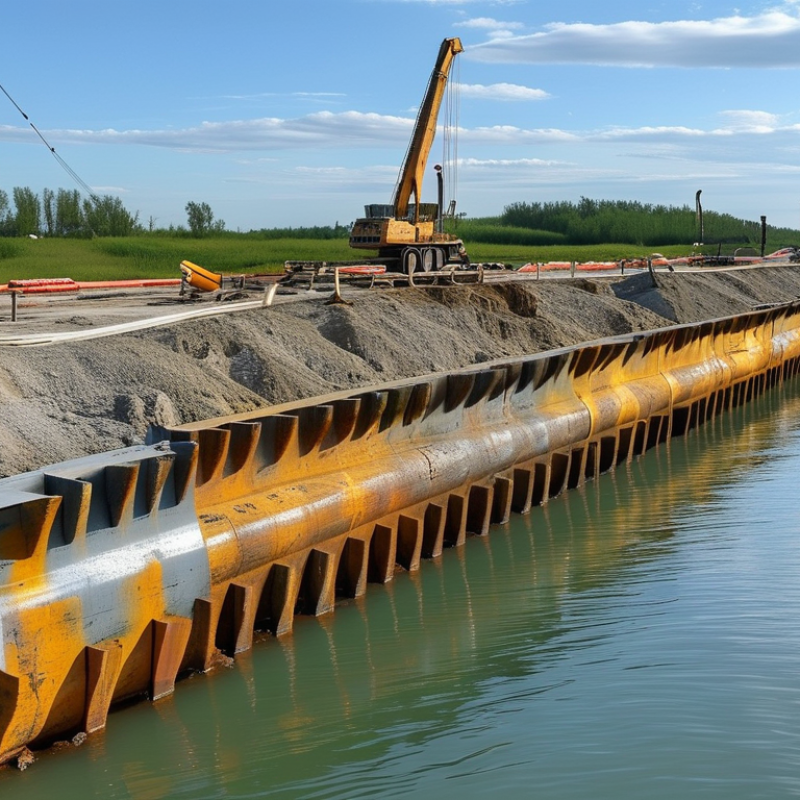
S235 steel sheet piles are widely used for temporary and permanent earth-retaining works. Their interlocking edges form a continuous wall around an excavation. Contractors commonly select them for basements, bridge abutments, road widening, and utility trenches. They also perform well in cofferdams, where water must be controlled during foundation construction. In coastal projects, engineers may use them for quay walls, flood barriers, and bank protection.
Site conditions determine the suitable pile profile and length. A deeper excavation may require stronger sections, internal bracing, or ground anchors. Driving equipment also matters, especially near homes, hospitals, or aging structures. Vibration can become a serious concern. S235 steel offers practical weldability and reliable structural performance, but it is not automatically suitable for every environment. Salty water, acidic soil, and repeated wetting can accelerate corrosion. Protective coatings or increased thickness may be necessary.
Tips: Confirm soil data before ordering. Check pile length, section modulus, interlock quality, and straightness. Ask for mill certificates and inspection records. A trial installation can reveal unexpected driving resistance. That step is often skipped. It should not be. For permanent works, review corrosion allowance, drainage, connection details, and design loads with a qualified engineer. Some projects appear simple on drawings, yet local groundwater or hard layers can change the installation plan quickly.
2026 Top Types of S235 Steel Sheet Pile for Global Buyers
Typical Construction Applications for S235 Steel Sheet Piles
The chart shows the minimum yield strength requirements for S235 structural steel by product thickness, based on EN 10025-2 values. S235 steel sheet piles are commonly supplied in U-shaped, Z-shaped, straight-web, and box-type profiles.
U-shaped piles are often selected for temporary retaining walls and cofferdams, while Z-shaped piles are widely used for quay walls, riverbank protection, flood defenses, and permanent earth-retaining structures. Straight-web and box-type profiles are typically used where interlock strength, water retention, or high bending resistance is important.
Reference basis: EN 10025-2 minimum yield strength requirements for S235 structural steel.